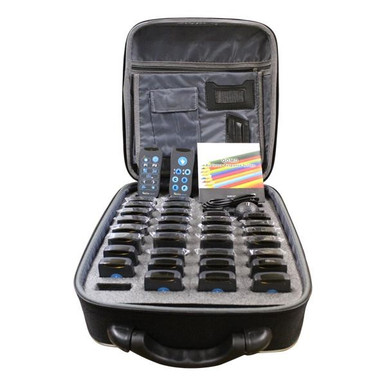
Two K-12 clicker systems, two very different purchasing stories. QOMO sells response kits as standalone products with a price you can read on a page. Boxlight's MimioVote grew up as part of the Mimio classroom ecosystem, which is excellent if the rest of your room is already Mimio and awkward if it is not. This comparison is really about how tightly you want your response system bound to the rest of your front-of-room hardware.
The one-line answer: buy the QOMO QClick QRF300 (from $687.88 for 12 remotes to $1,588.88 for 32) for a standalone class set with published pricing, a complete kit including receiver and teacher remote, and no dependence on any particular panel or whiteboard brand. Step up to the QOMO QClick QRF500 ($764.88 to $1,673.88) if the same set must also cover assemblies, since it handles up to 400 devices at a 250-foot range with six activity modes. Consider Boxlight MimioVote when your classrooms already run Mimio software and displays and you want assessment integrated into that ecosystem, but confirm current system pricing and availability with Boxlight or a reseller first, because the handsets are sold through the Boxlight store rather than at a published kit price like the QOMO line.
Read More
| Tool / Business / Provider | Score | Speed / Distance | Pricing / Details | Rating |
|---|---|---|---|---|
| Top Choice | Brand-neutral | From $687.88 (12-seat kit) | ★★★★★ | |
| PC-free operation | From $764.88 (12-seat kit) | ★★★★★ | ||
| Ecosystem-bound | Handsets via Boxlight store; system pricing by quote | ★★★★☆ |
The QRF300 is deliberately unopinionated about the rest of your classroom. It brings its own RF receiver, so it does not need a specific interactive display, a specific whiteboard, or a specific software suite already installed to function. For a district running a mixed fleet, which is most districts after a decade of staggered purchases, that neutrality is worth more than any single integration feature.
Roughly $50 to $57 per seat depending on pack size, once. If the room's panel is replaced in three years with a different brand, the clickers keep working, which is not something an ecosystem-bound system can promise.
Read More : https://www.encoredataproducts.com/audience-response-systems/qomo-qclick-qrf300-audience-response-system/The QRF500 is the same argument at a larger scale. It keeps the standalone receiver and brand-neutral design of the QRF300 and adds the capacity to run something bigger than a classroom, which in a K-12 building usually means the cafeteria, the auditorium, or a district in-service day where 200 teachers need to answer the same question.
At the 24-remote size it is roughly $44 per seat, the best per-seat value QOMO sells. It ranks below the QRF300 here only because this comparison is scoped to the ordinary classroom, where the extra capacity is not needed.
Read More : https://www.encoredataproducts.com/audience-response-systems/qomo-qclick-qrf500-audience-response-system/MimioVote is the assessment component of Boxlight's Mimio classroom line, and it makes the most sense in a room where the rest of the Mimio stack is already installed. Boxlight continues to publish MimioVote documentation and sells replacement handsets through its own store, so existing deployments have a support path, which is more than several discontinued clicker lines can say. The value proposition is integration: assessment that lives inside the same software teachers already use for lessons.
Outside a Mimio classroom the calculus flips. You are buying into one vendor's ecosystem for a function that a standalone kit performs without any such commitment, and the next display refresh becomes a decision that also affects your response system. Confirm current system availability and pricing with Boxlight before planning a purchase.
Read More : https://boxlight.com/support/documentation/mimiovote
Same neutrality, four times the device ceiling
MimioVote finishes third here on purchasing friction rather than classroom performance. Inside a Mimio room it does something neither QOMO kit attempts: it puts assessment directly into the same software stack that drives the lesson, with no second application to open. That is a real advantage, and Boxlight still supports the line with documentation and replacement handsets. But a response system bought as part of an ecosystem inherits that ecosystem's future, and most districts buying clickers in 2026 are running mixed front-of-room fleets. Buy MimioVote if your rooms are Mimio. Buy the QClick kits if your rooms are anything else, or several things at once.

If your classrooms are standardized on Mimio and you want assessment inside that software, evaluate MimioVote and get a current quote from Boxlight. If your fleet is mixed, or you want a response system that outlives the next display refresh, buy the QOMO QClick QRF300 at $687.88 to $1,588.88 for 12, 24, and 32-remote class packs, each complete with a teacher remote and receiver. If the same set should also cover assemblies and in-service days, the QRF500 at $764.88 to $1,673.88 adds 400-device capacity, a 250-foot range, six activity modes, and short-answer support.
The QOMO line's advantage in a K-12 purchase is boring and practical: a published price, a complete kit, no annual fees, and a single order that can sit alongside the headphones, document cameras, and charging carts a district is already buying. Encore Data Products stocks the QClick systems, accepts school and district purchase orders, and sells through TIPS 230901 and Choice Partners. Call 866-926-1669 for sizing or a quote.